


Nina Zeljković
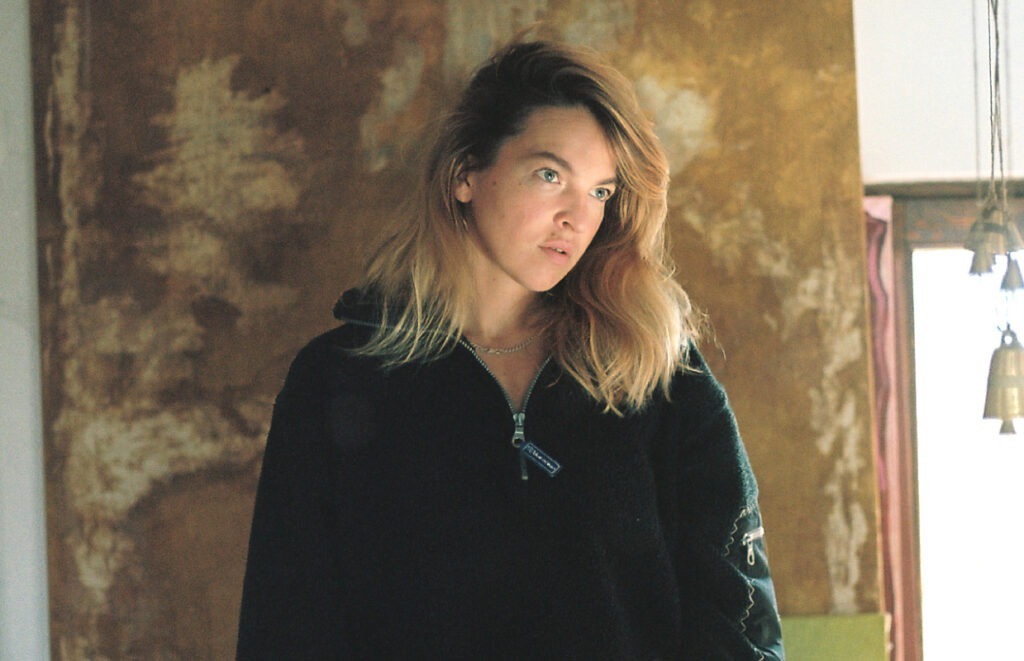
Nina Zeljković is a visual artist and conceptual painter. Her extended painting and video practice explores the painterly and architectural methods that can influence the body’s movements through space and activate its embodied knowledge.
Inspired by the attitude eastern christian iconography held towards images and which can be summarised in three main points: ‘Reverse’perspective, representational issues in Christian iconology and the iconoclastic debate; her painterly and cinematic inquiry seeks to create the decentralised space and challenge the cen-tral-point western perspective.
Nina Zeljković (*1985 in Belgrade) Graduated with MA in painting in the class of Jutta Koether, studied film and video in the class of Jeanne Faust and Angela Schanelec at HFBK Hamburg. Lives in Belgrade and Berlin.
She has had solo exhibitions at: Centre culturel de Serbie, Paris; Noncanonico, Belgrade; Holger Priess, Hamburg; Neue kunst in Hamburg; Note on, Berlin; U10, Belgrade; Ursula Walther, Dresden; and in various group shows: Belvedere 21, Vienna; Museu da Imagem e do Som, Sao Paolo; Martovski festival, Belgrade; Videonale, Bonn; Museo Madre, Napoli; Casa Mora, Napoli; Atopos, Athens; TAM, V.Tarnovo…
—-
Her architectural works for AWB suggest spatial history. Spatial history in art takes the approach that places are historically significant in that they are shaped by movements of people, objects, and information through space and by actions that delineate and redefine dedicated spaces. Geographer Doreen Massey thinks spaces as open, multiple, and relational, as unfinished and always in the process of becoming; therefore they were also a prerequisite for history to be open. Zeljković’s mobile architectural and purposefully provisional trompe l’œil elements are based on real sacral places visited by Zeljković during her research. These works are performative in nature, they can be folded, packed, easily transported, and very quickly overlaid over existing architecture playfully transforming a hard and solid structure into a new space of emergency, memory, assembly point, gathering, ritual, a church, a mosque, a social laboratory.